

- What are Hedge Funds?
Hedge funds sit on the buy-side of the financial services industry, which also pertains to asset managers, pension funds, private equity firms. Their mission is on a futile level to buy securities and to invest capital to generate returns for clients. Whereas on the sell-side, the entities are financial institutions, such as investment banks, elite boutiques, and brokers, with the core basic aim of essentially trying to sell a service.
- History:
Hedge Funds were founded in in 1949 with Alfred W. Jones, launching the first ‘hedged’ fund with $100,000 of capital, ($40,000 of his own contribution). Jones enacted the thesis of holding positions of stocks over the long-term, and having positions in stocks and short selling them, creating the L/S model. Hedge funds took off in the 1990s when interest in mutual funds abated, in conjunction with a favourable dotcom boom fuelling the 1990s equity bull market. Plus, George Soros’s short against the pound (borrowing the pound and selling it) through his hedge fund Quantum Fund. This trade earnt a $1 billion in one day in 1992. This garnered attention to hedge funds, as his $10 billion trade forced a devaluation of the pound and earnt Soros the title of the man who broke the Bank of England.
- How they trade:
Breaking down the name of Hegde Funds, they are intended to ‘hedge’ to off-set risk, keeping volatility to a minimum – to achieve alpha. Hedge funds are not intended to beat the S&P 500 per say, but achieve absolute returns, regardless of market conditions, hedge funds do not intend to ride the market up or down.
For instance, if the S&P returns 10% one year, and a hedge fund also returns 10%, but with a 0.5 beta, it’s the same return with less risk, its achieved alpha, which is risk adjusted for beta.
Hedge funds are accordingly given more autonomy over an investment bank, but in tandem with this, risk needs to be managed with very tight risk controls. This pertains to oversight on net exposure, factor exposure overlap, correlation matrices, and resultantly fast capital reallocation in a drawdown (losing position).
Hedge Funds operate using 3 main concepts:
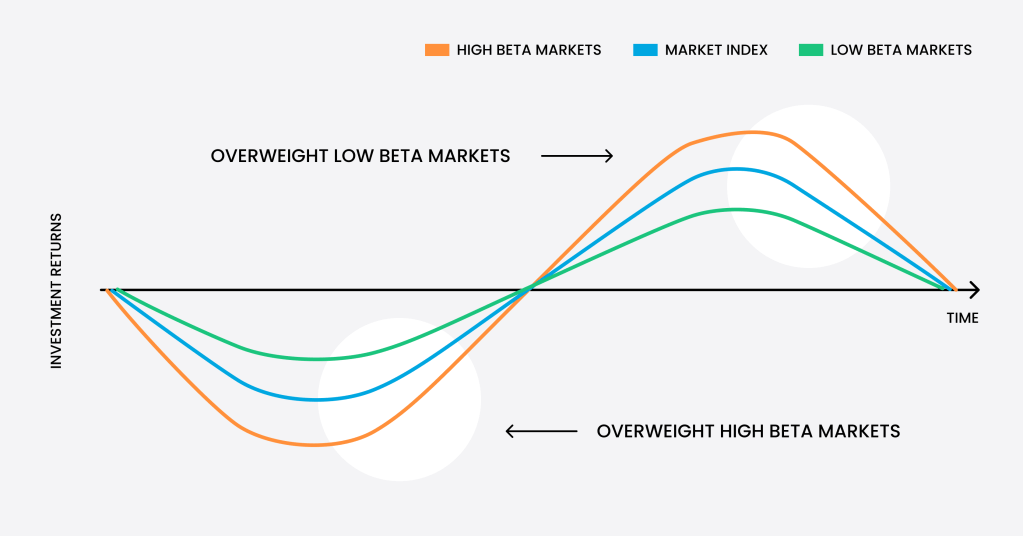
- Beta – Beta is a measure of how much an investment or portfolio moves relative to a market benchmark). A fund will monitor its beta of it positions to control. A fund may want to focus on alpha, so may neutralise beta to hedge exposure. Or a fund may target beta to amplify returns.
Beta of 1 = moves in line with the market.
Beta > 1 = more volatile than the market.
Beta < 1 = less volatile than the market.
Beta = 0 uncorrelated to the market.
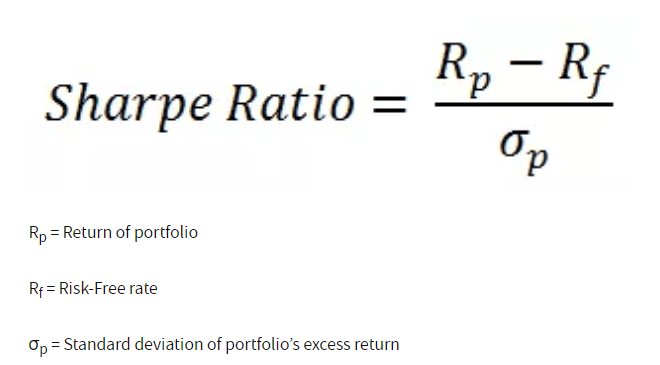
- Sharpe Ratio – this ratio is a measure of return per unit of total risk. A fund with a higher shape ratio will deliver more return per unit of total risk. The Sharpe ratio can indicate whether the raw returns are driven by high beta exposure, or returns due to actual skill.
- Alpha – Alpha is a measure of the excess return a portfolio will generate relative to its expected return based on market exposure.
Alpha > 0 = portfolio outperformed what was expected give its market exposure.
Alpha < 0 = underperformed relative to market exposure.
Alpha = 0 = performance explained by market moves.
- Hedge Fund Performance in 2025 & going into 2026:
Hedge funds returns last year stayed effectively, and returning on average was 11.8%, a tiny down from 2024 where they were 11.9%, according to Goldman Sachs. The FT reported a slightly different figure of 12.8% for 2025, which would make it the wider industries best performance since 2009.
With best performers being healthcare (33.8% gains) and energy and materials (23.4% gains). The winning hedge funds from last year Reuters writes, are Bridgewater’s Pure Alpha with a 34% gain, D.E Shaws Oculus fund which surged 28.3%, while too its Composite find with 18.5%, and in third place Balyasny with 16.7%. North America leads the Hedge Fund industry, controlling more than 37% of the global AUM, Bloomberg advances.
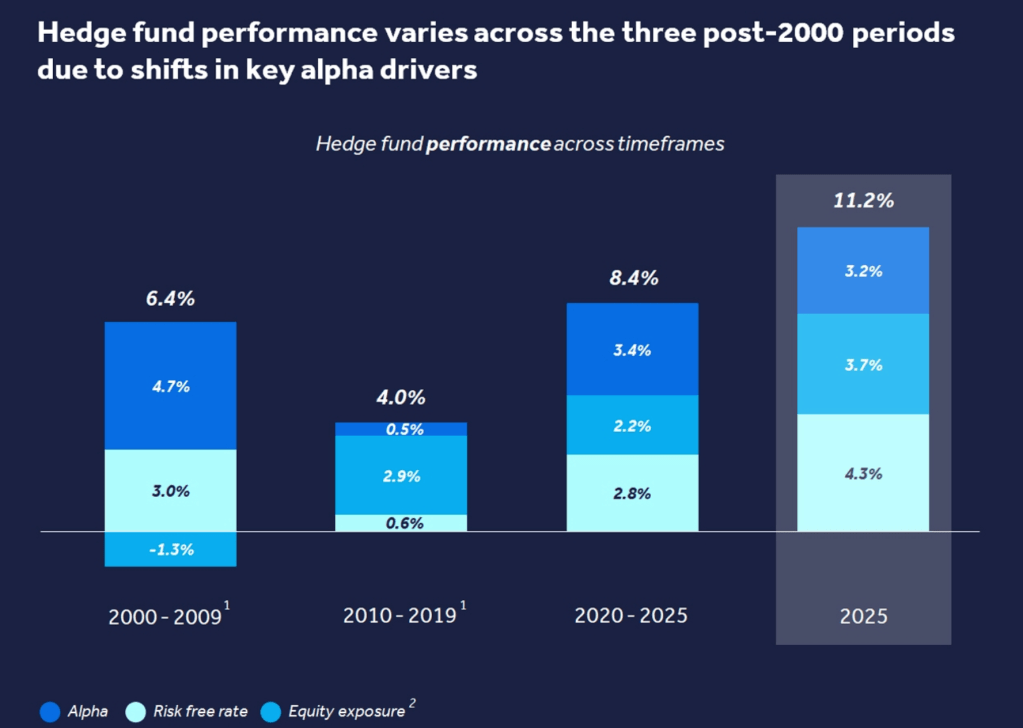
The beta has crept up recently across the board for the industry, this is in comparison to MSCI world index of 0.24, in the previous 5 years, this has been noticeably lower at 0.15. With this augmenting beta, comes low volatility in comparison to the MSCI, carrying through at 2.43% whereas the MSCI world index vol was 9.25% reports BNP Paribas. The capital allocation looks to take a turn this year, with orientation towards Europe, 34% of allocators plan to divest to this geography, in tandem APAC a 30% rise expected this year, ideally equity L/S.* Barclays suggests that alpha was at just 50bps for 2025.
- The future outlook for hedge funds in 2026:
BNP Paribas reported that one-fifth (21%) of allocators advocate the trading strategy which will deliver the highest returns in 2026 is discretionary macro.* This strategy is ‘where managers construct portfolios based on their top-down views of the world’, a human analysis of changes and shifts across geopolitical events to make subjective and adaptable investment thesis’s according to WTW. This stands in dichotomy to systematic macro trading, which is based on algorithmic rules-based mode decision making, purports the FT.
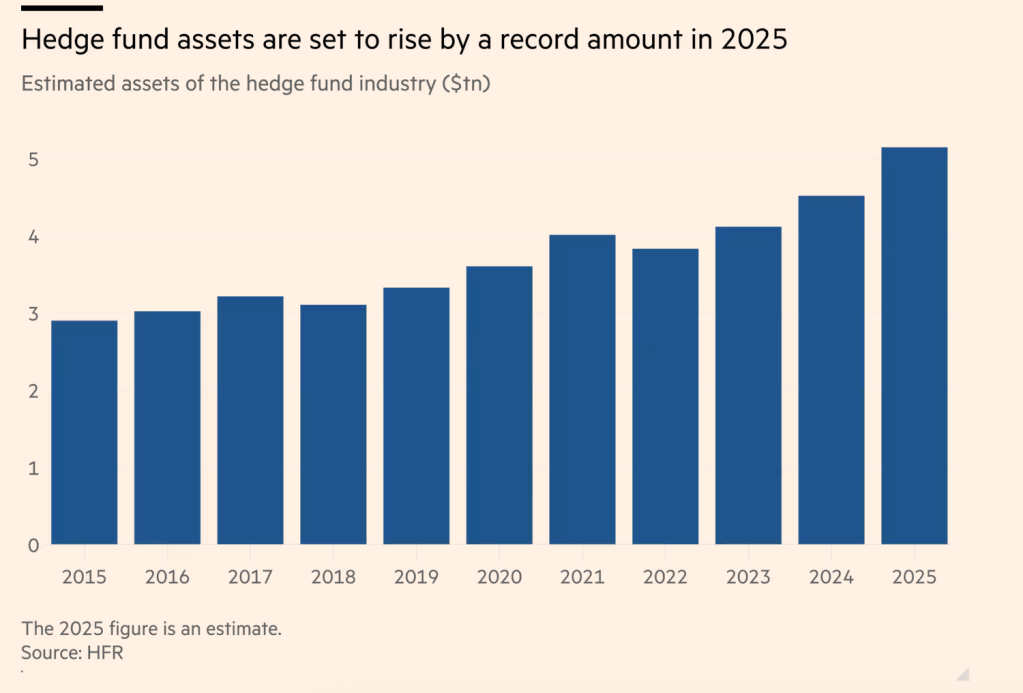
The industry sees a shortage a single, CIO, vintage style macro managers, which is where a Chief Investment Officer is responsible for setting investment strategies and overseeing active portfolio management. An ingressing change also being observed, is offshore hedge funds (e.g. in the Cayman Islands or British Virgin Islands) is one of the largest and fastest growing segments in the industry.* Barclays in their 2026 outlook, published Hedge funds are expected to reach $5.4 trillion in AUM by 2026.
*Information based off BNP Paribas’ CIP survey of 246 allocators concerning funds equating to $1.1 trillion, reflecting a sample of the broader market.
Disclaimer: not financial advice.
Sources:
https://globalmarkets.cib.bnpparibas/2026-hedge-fund-outlook/
https://www.ftadviser.com/partner-content/a87b45eb-3dc4-512c-b361-801613a3527d
https://www.ft.com/content/edded97b-49ce-4deb-8f5d-b6cecf989bbe
https://www.investopedia.com/ask/answers/08/george-soros-bank-of-england.asp
https://www.hsbc.co.uk/wealth/insights/learn-to-invest/start-investing/what-are-hedge-funds/
 Market Mindset
Leave a comment